Tuesday, November 4, 2008

Boating Down the Amazon, from Iquitos to Manaus


I took a high-speed tourist boat from Iquitos down the Amazon to the Brazil border in an 8 hour trip. I crossed the border from Santa Rosa, Peru, to Tabatinga, Brazil, by boat. Dealt with passport control, spent 1 night in the miserably poor and dirty town of Tabatinga. The next day I learned that the next high-speed tourist boat to Manaus (a 2 day trip) wouldn't depart for 5 days and that the next flight (which would be much more expensive), wouldn't leave till after that. The much slower passenger ferry would leave sooner but arrive later.


So I went to Tabatinga's more affluent sister city, Leticia, Colombia (no border formalities), and relaxed in a nicer hotel to wait for the high-speed boat.


The boat ride is disappointing, in that one doesn't see much of river life, other than locals commuting or fishing in motorized dug-outs and the occasional ferry. Though there is the option to get off a at port and catch a later boat.


The Amazon is very wide. (I read that there are sections so wide one cannot see both shores simultaneously due to the earth's curvature.) However, one can't appreciate its true breadth along this route because there are many islands along its course. And the boat doesn't get close enough to see what's occurring on the shore, except when briefly docking at towns.

Above: A typical view while boating down the Amazon.


The most interesting part of the trip was when the Brazilian border authorities questioned each of us and searched our boat and belongings as we neared Manaus. They didn't find anything interesting. It was a standard protocol that they were doing with all the boats.


Right: Manaus, a welcome sight. A city of 2 million on the western edge of most of the deforestation in the Brazilian Amazon Basin. Aside from its opera house (below, built when Manaus was the "Paris of the jungle" during the rubber boom of the 1800s), the city itself offers very little of interest to tourists. It is, however, the only place where I had delicious all-you-can-eat Brazilian barbecue (at Charruscaria Buffalo, near port -- no, buffalo wasn't on the menu).


Manaus is a launching point for excursions into the jungle. I read and heard from tourists that those to the south up the Madeira River are more exciting because that area is less populated than the north and it is easier to see wildlife. As I explained earlier, precipitation in Manu Cloud Forest finds its way to the Madeira before joining the Amazon.


Right: My hotel room during my 5 day stay in Manaus, while awaiting my flight to Rio. Easily the worst private room I've ever had. The ceiling was taller than the room was long. Shared bathroom outside.


Right: Manaus is most famous for the "Meeting of the Waters", where the dark waters of the Rio Negro from the north meet with the chocolate-milk waters of the Amazon a few miles east of the city. I spent $75 to hire a private taxi and boat to go to the spot because I didn't have enough time to join a tour before my flight to Rio de Janeiro. A couple pink river dolphins were swimming around this boat and ours. Dipping your hand into the water while passing from the black to the brown water is fun, because the brown water is much cooler.


The Meeting of the Waters, as seen from my airplane window on my departure for Rio. The waters of the Negro and the Amazon remain visually distinct for 11 km (6.5 miles) downstream of their intersection. Their merger is so gradual because the Negro has many more tannins, which make it darker, more acidic, and warmer, and the Amazon is very silty. So pH, temperature, and sedimentation gradients all contribute to maintain the rivers' differentiation. The Negro's low pH also reduces mosquito populations and the incidence of malaria in its watershed.


What Peruvians call the Amazon (from Nauta, Peru, eastward), Brazilians call the Solimoes. Brazilians call it the Solimoes until its union with the Negro, after which they call it the Amazon.


******************************************************************************************
An intriguing side-trip that I was considering but ran out of time to see, involves taking a bus or flight north from Manaus to Boa Vista, Brazil, near the border with Venezuela. After crossing the border into Venezuela, you reach Santa Elena de Uairen, which you use as a base for travels to Angel Falls and to Roraima, the highest tepui in the Gran Sabana.
Angel Falls is the world's tallest waterfall, over 3,200 ft, best seen in the wet season (though clouds can obscure the view), versus dry season, when the falls can diminish to a trickle.

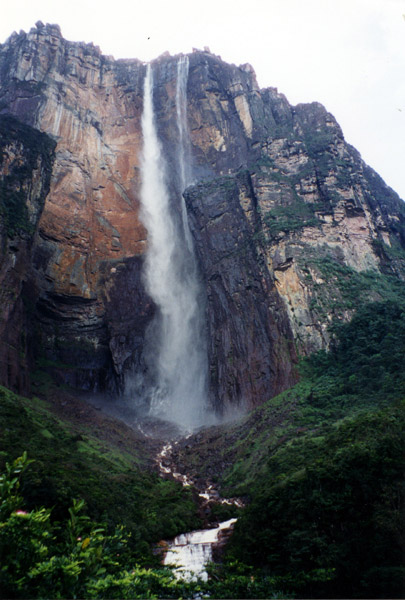
Typically, tourists hike into the base, so the lower pic is more likely what one would see. Perhaps the view in the higher pic can be seen if flying there from Santa Elena.
Angel Falls plunges from the top of a tepui, one of many plateaus rising from the Venezuelan jungle, formed by erosion.


Roraima tepui, elevation 9,200 ft. Because of tepuis' isolation, they possess many unique flora and fauna. Roraima was the inspiration for Arthur Conan Doyle's "Lost World". One can climb Roraima (guide required) on a 5 day trek, no technical skill needed, but hiring porters does make it easier.


Adding Angel Falls and Roraima tepui to my trip probably would have required 10 days. Easy and worthy enough to do on a separate trip to Venezuela some day.

The Amazon Jungle of Peru


I flew from Lima to Iquitos, in northeastern Peru. Though most travel books describe boat travel down the Ucayali River from Pucallpa to join the Amazon at Iquitos (about 300 miles and 1 week), I didn't have time. (I believe it's also possible to float down the Apurimac and eventually to the Ucayali on the way to Pucallpa -- though there were reputed to be dangerous cocaine traffickers in that area during my trip.)

Iquitos is an unusual city. With 400,000 inhabitants, it is the largest city in the world that is not reachable by road. It is famous for its legions of 3-wheeled motorized rickshaw taxis and motorcycles. I saw a family of 4 (2 of them infants) on one motorcycle, and, like everyone else in Iquitos, they were helmetless. Iquitos is the base for jungle excursions into the Amazon Basin in that part of Peru.

I stayed for 4 nights/5 days in facilities owned by the Explorama company. See http://www.explorama.com/

My jungle excursion started by taking a motorboat a short way down the Amazon (about an hour's ride) to Explorama Lodge.


Left: The rainstorm that hit while we boated to Explorama Lodge. It was literally a wall of water, which is visible between the boat's side on the left of the pic and the horizon on the right.


Right: The return of sunshine.


Explorama Lodge was founded in 1965 by an American biology teacher who fell in love with the jungle and natives around Iquitos. It is one of the first jungle lodges in the area. Explorama now has several other facilities in the area too. I leapfrogged between them deeper into the jungle until I reached the most remote one, ExplorTambo Camp.


Views of Explorama Lodge.


Left: My "room" -- open to the elements and mosquitos -- at Explorama Lodge. Respite was found under the mosquito netting. Bathroom had running water, shower, and toilet.

Below left & right: Walkway at Explorama, during the day and at night, illuminated by kerosene lamps.


Two macaws at the Explorama Lodge. Though these are not mates, macaws mate for life, unlike parrots, which are a smaller type of macaw.

Below right: Butterfly resting on goalpost at Explorama Lodge. More evidence (to me) that butterflies are attracted to their own color.


Yagua natives demonstrating blowgun technique.
This Yagua village is only a 5 minute walk from Explorama Lodge. Explorama had developed a close relationship with the Yaguas, who benefited financially from tourism.

Below right: Yaguas performing traditional dances in communal hut financed by Explorama, using Yagua building materials and methods. Explorama had paid for the hut because the Yagua youth were embarrassed by tourists seeing their homes.


The most troubling part of the Yagua visit is that there were no young to middle-aged males present -- all of them had gone to Iquitos for work, in order to send money home to their families. This is a very common phenomenon in the Amazon Basin. In fact, my guide for the 5 days with Explorama, had done the same, leaving his village in Amazonian Ecuador. Forty years ago there were 280 Yagua families here, now there are 40.


Left: Baby sloth, a pet of one of the Yagua girls. (There is red plant dye visible on my nose.)

Sloth family reunion?
The sloth was intrigued by my beard (none of the other tourists had a beard, and natives don't).

Right: The only piranha I caught. I was the last to catch one during our second hour-long effort.


Close-ups of the beast, of the so-called "red-bellied" variety, noted for being especially aggressive (and supposedly easier to catch).


That night's dinner . . .

. . . a bit greasy, but good flavor.


Left: Medical clinic build by Explorama near Explorama Lodge to benefit the Yaguas and other locals. Originally staffed by Linnea Smith, MD, of Wisconsin, who fell in love with the area and people when she visited once on vacation. She wrote a book about the experience entitled, "La Doctora".


Unfortunately the river is eroding the shoreline dangerously close to the clinic and a new one will have to be built soon. For this reason, they are not currently accepting western medical volunteers.

Trung, an Australian medical student doing overseas research on international healthcare disparities, is seen here taking a photo of the erosion threatening the clinic.

Left: The house built for Dr. Smith by Explorama.


ExplorNapo is the second facility owned by Explorama that I visited. It is located up the Napo River, which originates in Ecuador and is a major tributary of the Amazon, joining it just downstream from Iquitos. It is slightly more rustic than Explorama Lodge, with shared showers and pit toilets. I spent my second night there, and it is from there, in fact, that we did our piranha fishing.

Right: Julio, a shaman at ExplorNapo's ethnobotanical garden, spent 2 hours explaining the medicinal properties of many indigenous plants to me (through my guide-interpreter). One called buton d'oro ("golden button") is used to soothe toothaches as well as bites or stings from spiders, scorpions, centipedes, bees, ants, and wasps. He gave me a piece to chew and that part of my mouth went numb. Another plant, pronounced "Sacha Hairgone" (which means "like the fer-de-lance", based on its appearance), is used to slow the venom of the fer-de-lance, bushmaster, and coral snakes, which are the only varieties of poisonous snakes in the Amazon Basin. He showed me another plant ("Ahos sacha sylvestre", a type of wild garlic) used for bronchitis, sinusitis, and asthma. "Suelda con suelda" was ground into a paste to apply over bone fractures, followed by splinting for 15 days. He showed me many other plants, used to treat hyperglycemia, ear pain, parasitic GI infections, skin fungal infections, blood coagulant ("sangre de grada"), another for both conjunctivitis and mosquito repellant, others for epigastric pain and nausea and vomiting, and mumps. He also showed me Santa Maria, which he stated was related to aspirin and used to reduce fever, headache, and inflammation.
He had prepared ayahuasca, which he was going to drink that night to go into a trance to determine how to diagnose and treat some of his patients. He allowed me to smell it. It was quite pungent. Tourists can participate in ayahuasca ceremonies led by a shaman, but it is not something to be taken lightly because some people have suffered permanent mental changes after ingesting it. It is an intense hallucinogen that provokes anxiety, as well as severe nausea, vomiting, and diarrhea. I had asked my rafting guide Kali about ayahuasca and he said it was very dangerous. Because of its power, it has achieved religious significance. Its name means "vine of the dead". The ceremonies begin with purification rituals, including fasting and bathing, before the drug is drunk. The full ceremony takes about 48 hours. The shaman guides the individual through the process, including interpretation of the person's visions afterward. San Pedro cactus (the hallucinogen used by the Chavin priests) is also available and not considered as dangerous. I didn't try either.
That night my guide and I spent over an hour walking about a 200 m loop in the jungle near ExplorNapo. Following are pics of what we found.

Left: Poison dart frog.

Right: Large grasshopper.


Below: Beetle with phosphorescent spots.

Below: Bird spider -- at 5'' wide only half of maximum size.


Right: Queen Victoria (aka "Regina" or "Amazon giant") lily pads. These were only 3-4 ft across, but they get up to 7 ft across and large enough to support the weight of a kneeling man.

Below: Catepillars feasting on a leaf.


Below & right: Some interesting lianas, woody plants that piggy-back up other trees toward sunlight. (They are not vines -- lianas are woody.) The most famous type of liana is ayahuasca, the hallucinogenic plant used by shamans.


Right: Small patch of deforestation on our way to the lily pads.


Left: A tree of name unknown to me with thorns on its bark.


Indigenous people would use the buttresses of roots like these as keels when carving out tree trunks to make canoes.


The Amazon Conservatory of Tropical Studies, built by Explorama, is devoted to scientific research, but it also offers rustic tourist accommodations on a par with ExplorNapo Lodge. ACTS is only a 2 mile jungle walk from ExplorNapo.


The highlight of ACTS is the nearby Canopy Walkway. It was built by Explorama and cost $10 million. It is one of the first and largest canopy walkways in the world, almost 2000 ft long and spanning from ground level up to 120 ft high, from where one can see over most of the trees.

Right: A variety of lizard only discovered after construction of the Canopy Walkway. The more visible of the two lizards pictured has a black body, white collar, and brown head. The less obvious one is along the profile of the tree -- it has a more uniformly greenish-brown body with a less apparent collar. Both had the same body shape, including a flattened broad tail. I don't know if their color differences were due to sex or subspecies differentiation.

Ecologists have called rain forest canopy the "eighth continent" because of the previously unknown species to be found there.

Unfortunately I didn't see nearly as much life as I had hoped on the walkway. It is open to tourists (guide required) during all hours of daylight. I was told by my guide that in previous years birds were much more frequently seen when access was limited only to researchers.

Left: A fer-de-lance that was almost stepped on by my cook, who was wearing flip-flops, during our walk from the Canopy Walkway to ExplorTambo Camp, Explorama's most remote lodging. Fer-de-lance poison can kill a person.

The 10-minute walk was quite eventful: after the fer-de-lance, the cook announced that we had to run because we were now sharing the trail with a colony of army ants who were on the march; then my guide and I each got stung by bees on the face.


Right: ExplorTambo Camp. I slept under the white net on the right side of the pic. The kitchen and dining room are in the enclosed hut on the left side. My guide and cook slept while an Explorama employee stayed up all night, just in case a jaguar or bushmaster snake came a-prowling.


The following pics are from the web and are of animals that I saw but didn't get good photos of.

Below: Saddle-back tamarin.


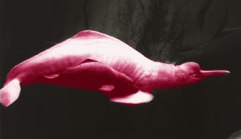
Below: Pink river dolphins. The Amazon contains 2 of the world's 5 freshwater dolphin species, pinks and grays. The pinks are large and sluggish, while the grays are smaller and more athletic, more like their ocean-going kin. We went up the Amazon from Explorama to the mouth of the Santa Martha River, where we saw 20 or so pink dolphins (or the same ones many times). They congregate at river mouths because that's where fish they eat concentrate due to the abundance of food at these locations. River mouths are also where we fished for piranhas for that reason. The dolphins eat piranhas without being harmed.


Right: Bushmaster snake. A pit viper capable of reaching 10 ft in length. Very aggressive. My guide said the natives fear the bushmaster more than the jaguar. He explained that, while he didn't believe in the myths that male dolphins will impregnate virgins while they are swimming, he did believe that the bushmaster does coil up like a spring and bounce through the forest faster than a man can run in order to bite its prey, whether man or animal.
*************************************************************************************
This may be cheesy, but after I got home, for Christmas I received the Pulitzer-prize winning book of poetry by Robert Hass entitled, "Time & Materials". It contains a poem named "State of the Planet". One section of that poem is about the Amazon jungle around the Napo River, near where I was at the ExplorNapo Lodge. The poem describes the look and feel of the place better than my pictures. (Incidentally, "selva" is Spanish for jungle.)
The people who live in Tena, on the Napo River,
Say that the black, viscid stuff that pools in the selva
Is the blood of the rainbow boa curled in the earth's core.
The great trees in that forest house ten thousands of kinds
Of beetle, reptiles no human eye has ever seen changing
Color on the hot, green, hardly changing leaves
Whenever a faint breeze stirs them. In the understory
Bromeliads and orchids whose flecked petals and womb-
Or mouth-like flowers are the shapes of desire
In human dreams. And butterflies, larger than her palm
Held up to catch a ball or ward off fear. Along the river
Wide-leaved banyans where flocks of raucous parrots,
Fruit-eaters and seed-eaters, rise in startled flares
Of red and yellow and bright green. It will seem to be poetry
Forgetting its promise of sobriety to say the rosy shinings
In the thick brown current are small dolphins rising
To the surface where gouts of the oil that burns inside
The engine of the car I'm driving oozes from the banks.
Leave it to a poet to end with a downer.