Sunday, January 4, 2009

Epilogue: My New Home in Bellingham, WA


I returned to Yakima from South America on October 25, 2008. The day after the Presidential election I drove to Bellingham, WA, to find a place to live. I was scheduled to start my new job as a physician assistant in the Orthopedic Surgery and Sports Medicine Clinic at St. Joseph's Hospital later in November.


The first apartment I looked at is on Lake Samish, 15 miles south of my job, with quick access via I-5. It's the downstairs of a 2-story house -- the upstairs is at ground level on the front of the house, the downstairs is at ground level on the back, facing the lake. There's a dock, a beach with benches and a firepit, and a fireplace inside. I looked at a dozen other places that day but nothing else came close.


Lake Samish at sunrise.


The dock.


The beach.


A deer that periodically visits. I think it likes my backyard because it's one of the biggest facing the lake (away from the road).


A double rainbow after a December rain.


My backyard under a late December snow.


I'm loving my new home and job. Give me a call if you're in town.

Happy 2009,

Jud

Thursday, January 1, 2009

Resources

This is arranged in 3 sections: Travel Information, Volunteer & Donation Opportunities, and Latin American Literature that I read (in English) during the trip.

Travel Information:

•Much of trip inspired by BBC’s “Planet Earth” (not “Indiana Jones & the Kingdom of the Crystal Skull” -- all similarities are coincidental).

•Guidebooks: Lonely Planet’s “Peru”, “South America”, & “Trekking in the Central Andes”; Bradt’s “Amazon”.

•www.saexplorers.com: South American Explorers non-profit travel organization.

•www.galaxia-expeditions.com & www.hauraz.com/casadeguias: Andean trekking near Hauraz, Peru (save $ by emailing burro-handler Ezer Santos (Spanish only) directly at dizansantos10@hotmail.com).

•www.inkajungletrail.com: Adventure travel to Machu Picchu (this agency pioneered the route; ask for guide Juan Carlos (and ask him about “las sagradas parablas”, but only if you’re male)).

•www.amazonas-explorer.com: Rafting the Apurimac near Cusco; excellent safety & environmental record.

•www.manuperu.com: Manu Cloud Forest Lodge (1st lodge in Peru’s cloud forest & only one donating part of proceeds to Manu Nat’l Park; ask for guide Humberto (master’s degree)).

•www.andeantravelweb.com/peru/companies/peru/manuexpeditions.html: one agency that arranges stays at Casa Machiguenga, rustic lodge owned & run by indigenous tribe in Manu National Park.

•www.quexplo.com & www.colcatrek.com: Colca Canyon & climbs of Chachani, Volcan Misti, or other peaks around Arequipa, Peru.

•www.explorama.com: Amazon rain forest near Iquitos, Peru (with a range of accommodations in the jungle, founded by a biology teacher 40 years ago, donates services to scientists & medical providers to advance ecological research & preserve culture of & provide medical care to indigenous people).

•www.pantanaltrekking.com: Ecological Expeditions – highly recommended by Lonely Planet but I didn’t see anything particularly “ecological” about them, felt that our guide harassed wildlife, & 4 people out of 8 on our 4 day tour had 24 hour bouts of upper GI cramps, nausea, & vomiting (I was the lucky one who also got diarrhea), so I suspect food or water was prepared improperly.

•www.riosuperfly.com.br: Hang-gliding with agency owned by former Microsoft lawyer and tandem hang-gliding pioneer, Huy (“Ruy”) Marra.


Volunteer & Donation Opportunities:

•www.rifugi-omg.org; andesdboscousa@yahoo.com: climbing guide school near Huaraz for Peruvians set up by priest Don Bosco; has affiliated hospital.

•www.amazonmedical.org; amp@amazonmedical.org: Explorama clinic founded by Linnea J Smith, MD, author of “La Doctora”, which chronicles her experience in the Amazon. Currently not accepting medical volunteers because of riverbank erosion threatening clinic.

•Amazon Rainforest Adopt-A-School Program, in conjunction with Detroit Zoological Society: Claire Lannoye at clannoye@dzs.org or Pam Bucur de Arevalo at conapac@explorama.com.

•Paul Farmer’s Partners In Health foundation’s work in Lima: www.pih.org/youcando/join/Peru_Posiciones_2008_(2).pdf. Dr. Farmer’s inspiring work is the subject of Tracy Kidder’s Pulitzer Prize-winning book, “Mountains Beyond Mountains”. Dr. Farmer single-handedly changed how the World Health Organization treats multi-drug resistant TB, based largely on his work in Lima. The book is required reading for all incoming University of Washington freshmen.

Literature:

•Mario Vargas Llosa, an author from Arequipa, Peru, compared to Colombia’s Gabriel Garcia Marquez (Nobel Prize-winning author of “100 Years of Solitude” and “Love in the Time of Cholera” – their friendship ended when Llosa punched Marquez). I read Llosa’s “The Feast of the Goat”, about Dominican Republic dictator Rafael Trujillo, and “The War of the End of the World", about a 19th-century messianic rebellion that withstood the Brazilian army for months. These are considered his greatest works, and I believe “Feast” is the best novel I’ve ever read – a great story and he uses storytelling experiments that I haven’t seen before, and they work well. Interestingly, Llosa served on a commission investigating a massacre by the Shining Path.

•Che Guevera’s “Motorcycle Diaries”, which follows the young medical student’s route with a friend from Argentina up the Andes to northern South America. A lot of the book is devoted to Peru – Machu Picchu, a leper colony near Iquitos (where Che volunteered for 3 weeks), and other sites. Reminiscent of Kerouac’s “On the Road”, but Guevera’s emerging pan-Hispano-Americanism and socialism lends it a far less hedonistic bent. Incidentally, after assisting Castro’s Cuban revolution, Guevera was killed while planning another revolution in Bolivia. Strange that he is idolized for attempting to do exactly what the Shining Path is vilified for doing.

Mexican actor Gael Garcia Bernal (also in "Babel", "Y tu mama tambien", and "Amores perros", all Oscar-nominated) stars in a 2004 movie version of the book. I haven't seen it, but it has received many favorable reviews (83% of critics, per rottentomatoes.com).

Tuesday, November 4, 2008

Conclusion

I definitely plan to go back. There are so many things I wanted to see and do that were just a little too far away with the amount of time I had. Here's a list of future South American trip ideas, with the best season to visit weather-wise:


•Peru: Santa Cruz trek in Cordillera Blanca (4 days, Alpamayo “prettiest mountain in world”), Trujillo/Chan Chan (beach & Chimu ruins, largest mudbrick), ruins of Chachapoyas' culture at Kuelap (rivaling Machu Picchu but preceding Incas by 1000 years), canoe from Lagunas to see dolphins (in mating season, when males lift rocks in bill) in Pacaya-Samaria Reserve, trek to Vilcabamba & back to Choquequirao to Machu Picchu (18 days, hire guide in Huancacalle), Moray Incan garden amphitheatre, boat from Pucallpa down Ucayali to Iquitos – 1 month in June-Sept.

For those interested, fellow tourists told me that Ecuador was very similar to Peru (Andes & Amazon), but sites were much closer together and easier to get to.


•Venezuela: Angel Falls, Roraima tupui, possibly Kateira Falls (highest single drop, in neighoring western Guyana) – 2-3 weeks in Oct-Nov.


•Brazil: Carnaval (late Feb), Salvador, the Panatanal (south floods in March) – 3 weeks in Feb-March.


•Argentina: Tierra del Fuego (+/- Antarctica by boat, Dec-Feb), up Che Guevera’s route in "The Motorcycle Diaries" thru Patagonia to Mendoza (wine & fall colors), Aconcagua climb (22,800 ft/6960 m; tallest outside Himalayas), non-technical, Dec 1-March 1, minimum 18 days & $3,ooo if use agency), Rosario, Cordoba – 1 month in Feb.

Buenos Aires


I took the most fun overnight bus ride of the trip from Iguazu to Buenos Aires. I was in first class with a 30-something Argentinian male from Pategonia, who is an avid fly fisherman, mountain climber, skier, and snowboarder. He is a ski instructor in the US during Argentina's summer. He's traveled all over Patagonia. There were also four young American tourists from the Bay area with us.

Argentinians are classy people. The bus provided complimentary glasses of wine and liquor to go with our dinner, along with a movie. We had a good time.


I arrived in Buenos Aires around noon, checked into my hotel, and went straight to La Cabrera, a restaurant that Lonely Planet said is expensive but well-worth the splurge. Frankly, I had the best meal of my life for $40 (incl tip), which included a 30-oz ribeye steak, with a variety of sauces, sauteed mushrooms, and other condiments on the side, and 2 large glasses of a delicious Argentinian malbec. Inexpensive in my book.

I took this pic after already eating a fair amount of the steak.


That night I joined a tour group (through http://www.tangol.com/) to see a soccer game between River Plate, last year's Argentinian league champions, and the Guadalajara Chivas in a South American Cup quarterfinal match. River Plate is in last place this year in the Argentinian league, so the fans were very flustered. They (including a pre-kindergarten-age girl) were singing chants to the effect of "You better win or I should play because I'm better than you." (I suspect something was lost in the translation by my guide.)


At half-time, River Plate was down 1-0. The fans were calling them sons-a-bitches and thieves for taking their salaries but failing to perform. The contrast with US fans, who tend to suffer with their teams rather than getting hostile toward them, was enormous. River Plate lost 1-0, and our guide quickly ushered us out of the stadium because he feared violence. Incidentally, River Plate's coach is famous for having kicked Beckham when the coach played for a European team.


The next day, I walked around the main tourist sites before catching my plane to return home.


A large sculpture of a flower that electrically opens in the morning and closes in the evening.


The remaining photos are of Recoleta Cemetery. To me, it is the most interesting site in Buenos Aires.

The tombs are erected on privately-owned plots of land. Each tomb can hold about 2 dozen bodies. Wealthy and well-known Argentinians are buried here and the tombs are maintained by the family. (Some are in decay due to declines in family wealth.)


There are walkways between connected plots that resemble city blocks, and the different architectural styles of the tombs resemble buildings.

It seems like a true necropolis ("city of the dead").


Right: The gold mosaic under the dome of the tomb pictured above. This is the largest tomb in the cemetery.


I think this is the prettiest tombI saw in Recoleta. It is for Liliana Crociati, a 26-year-old woman who was killed with her new husband by an avalanche during their honeymoon in Switzerland. A new rose is placed in her hand everyday. The sculpted dog was her childhood pet.


Evita is entombed in her family's crypt. Many visitors leave flowers for her. She died of cervical cancer at age 33 in Italy and is popular among Argentinians, for having championed many progressive causes, including woman's and labor rights and aid for the poor. She was initially buried in Italy at an unknown location, but was found later and returned to Buenos Aires. Her husband Juan Peron is buried in Europe (where he fled in exile from Argentina after a military coup) and they had no children. There is some controversy regarding whether he was a fascist.


The most disturbing tomb I was told about. A young girl was buried there. Several days later a cemetery caretaker heard cries and pounding coming from the inside. At that time, only family members had keys to the crypts. By the time family was located and the tomb opened, the girl was dead. She had epilepsy and a seizure-induced coma was confused for death.

Iguazu Falls


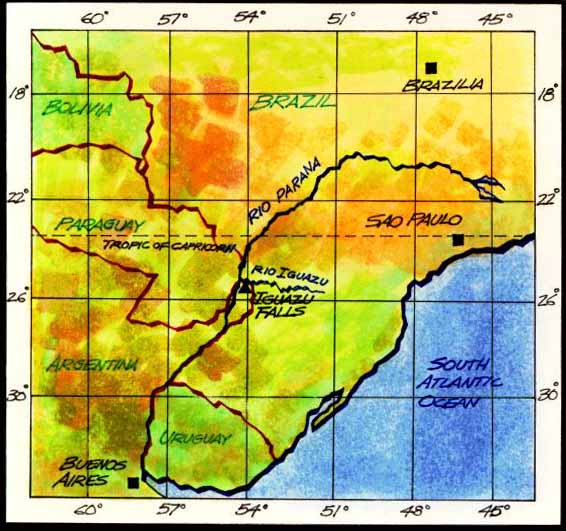
Iguazu Falls was my favorite natural wonder of the trip. It has more annual flow than any other waterfall. It is comprised of 270 separate falls spanning 2/3 of a 2.7 km span. It is over twice the size of Niagara and is rivaled only by the Zambezi River's Victoria Falls in southern Africa. It is formed by the Iguazu River, a tributary of the Parana River (responsible for the Pantanal's flooding), which plunges over a plateau on Brazil's border with Argentina. Iguazu Falls is a UNESCO World Heritage Site.


I took an overnight bus from Campo Grande to Iguazu. I went straight to Brazil's Iguacu National Park (it's spelled with a "c" instead of a "z" in Portuguese) and took a helicopter ride over the falls. While Argentina's side of the falls has better views and more tourist activities, one can only book a helicopter ride on the Brazilian side.


Approaching the falls.


The thin structure spanning the water is a walkway from which tourists can peer into "La Garganta del Diablo", the largest of the falls. La Garganta plunges over 200 ft and sends mist 500 ft into the air, creating what are probably among the world's most beautiful rainbows.


La Garganta del Diablo.


Above: The wide river to the right of the pic is the Upper Iguazu (above the falls) and the narrow river to the left is the Lower Iguazu.

Below: Imagining this photo taped to the bottom left corner of the pic above, one gets a sense of the position of the falls after the horseshoe in the Upper Iguazu.


I went to the town of Iguazu across the border in Argentina. It is much more quaint and pleasant than its sister city on the Brazilian side. The next day I visited Argentina's Iguazu National Park. Here are pics from the Lower Falls Trail.


I took a boat ride to the lower falls that morning. Here is a self-portrait just prior to getting soaked (they advised us to put our cameras away).


Below: Where our boat ended up.


Below are pics from the Upper Falls Trail, which one takes to reach the Garganta del Diablo overlook.


La Garganta del Diablo. When the breeze picked up, the mist soaked us.

Awe-inspiring . . . and giddiness contagious.


Argentina on the left, Brazil on the right.


The Pantanal, the World's Largest Wetland


The Paraguay River floods during the rainy season (the early part of each year), creating the world's largest wetland in the Pantanal region of southwestern Brazil, which crosses the border into eastern Bolivia and Paraguay. (Mato Grosso and Mato Grosso do Sol are states.)

The Pantanal has the greatest variety of wetland flora as well as one of the largest populations of large animals in the world. Ecologists consider it as important as the Amazon rainforest. Large animals are easiest to see during the flood, because they congregate on islands. However, travel during flood season is by small motor boat, so it's inconvenient for tourism.

I was there in the dry season. I took an overnight bus from Rio de Janeiro to Campo Grande, and then clambered into a van for an all-day drive into the Pantanal's interior, for a 3 night stay at a hammock lodge managed by Ecological Expeditions, a company based in Campo Grande. www.pantanaltrekking.com/ The company is recommended by Lonely Planet, but I wasn't as impressed with it compared to the companies I dealt with in the Amazon. Our guide seemed to harass (and to encourage us to harass) animals, and 4 out of the 8 people staying at the lodge contracted a GI illness with abdominal cramps, nausea, and vomiting (I was the lucky one who also got diarrhea). I suspect this had to do with meal preparation, because we had the same side dishes night after night, or with improperly treated water, because the water was stored in an above-ground cistern.

The Pantanal is savanna -- broad grassland with clumps of trees -- dotted with cylindrical ant mounds up to 1 meter tall.


Our hammock lodge.


There were many caracaras at the lodge. A type of falcon, content with scavenging for food waste from our meals. I got this pic from the web.


A couple of caimans relaxing near our lodge. One of my favorite Pantanal experiences occurred on our first night, under a full moon, when we walked down to the point of sand in the top right of this pic and watched frogs trying to jump and swim passed caimans to enter the channel across the top of the pic to go downstream. You could hear the caimans lunge and snap their jaws trying to catch the frogs.
As we walked back to camp, we saw dozens of phosphorescent glow-worms scattered across the sand.

More caimans seen on a boat ride 2 days later.

These are white caimans, relatively small (about 8 ft max), and non-aggressive toward humans (unless threatened).


Note the green algae on this one's back.


Our guide holding a baby caiman.


The 2nd day we took a horse-back ride in the savanna. Here are 3 Dutch medical students who were at the lodge while I was there (l to r: Giraun, Inga, & Martin). There was also an English ER doc at the lodge. Both Holland and England recently legalized physician assistant medical practice. And in both Holland and England, students go straight from high school to medical school based on test scores. (I also met an English law student who said it was the same process for him.) We talked a lot about medical education, physician assistants, and socialized medicine.


We found an armadillo on the ride. Armadillos are related to anteaters and sloths.


We also saw 2 mated pairs of hyacinth macaws on the ride. Macaws mate for life, and the hyacinth variety are often considered the most beautiful. Another pic I took from the web.


On our boat ride, we saw tuiuiu storks, the symbol of the Pantanal. They have a 10 ft wing-span and are often solitary. The pic to the right I copied from the web, the others I took myself.


Two tuiuiu storks fishing, while a small caiman waits to their left, hoping to steal anything they may catch.


Below: We saw many capybaras in the Pantanal. The capybara is the largest rodent in the world, up 140 pounds and over 4 ft long. They have webbed feet and escape from land predators by jumping into water. This is a good pic of an adult compared to offspring size that I got from the web.


Right: Four baby capybaras that we found after their parents ran into nearby forest. We separated our group to let them run between us to join their parents.

Capybara have long been hunted by natives. Some environmental groups advocate raising them for human consumption because they provide more protein per acre than cattle, with the bonus that their farming doesn't require deforestation.


Howler monkeys we riled up during a walk through a grove of trees on the savanna. Males' voices can travel 10 miles. The only animal capable of making a louder sound is a blue whale.

Howling with these was even more fun than watching caimans hunt frogs under a full moon.


A pic of howlers I took from the web. Females are brown and males are black.


Below: A rhinoceros beetle.


We also saw a toucan, but I didn't get a good photo so I took this from the web.


Below: Some interesting lianas growing up trees that we saw during a walk.